
Jet’s Pizza
Simplifying complex enterprise ordering for franchise customers
Senior Product Designer
Platform
Desktop
Product
Enterprise SaaS
Project Timeframe
Jan 2024 - Sep 2025
Role
In January 2024, Jet’s Pizza partnered with LOKE to migrate its entire U.S. franchise network onto a new digital ordering platform.
I led the redesign of the desktop experience, restructuring modifier hierarchies, simplifying half-and-half configuration and revamped the look and feel of the whole order platform. The phased rollout concluded in Feb 2026, successfully deploying all 475 locations and establishing a scalable enterprise framework for future pizza brands.
The Challenge
Jets Pizza’s ordering experience was built on legacy POS structures, resulting in deeply layered menu logic and complex modifier dependencies. High levels of customization added further friction around quantity selection, pricing, and cart representation.
Key Friction Points
Project Summary
Jet's branding needed to balance with LOKE platform constraints
Pricing updates weren't immediately obvious
Half & Half pizza selections were difficult to interpret
Deeply nested options created visual and cognitive overload
Before redesigning the front-end customer experience, it was important to understand how menu data was structured within Jet’s existing POS (point of sale) systems.
Jet’s ordering experience was built directly on top of legacy POS logic. Menu items, modifiers, and pricing rules were structured for operational flexibility - not customer clarity.
As shown above, this resulted in deeply nested option groups, long stacked lists, and inline rule messaging that required customers to interpret system logic as they configured their pizza.
Legacy Nested Options Experience
Once a pizza base was selected, the product page exposed multiple layers of dependent options - size, crust, toppings, flavour variants, bake style - many of which influenced price.
Rather than guiding customers through configuration, the both interfaces surfaced all rules and limits inline, creating dense screens that demanded a lot of cognitive processing to comprehend.
Legacy Half Half Experience
Once a pizza base was selected, the product page exposed multiple layers of dependent options - size, crust, toppings, flavour variants, bake style - many of which influenced price.
Rather than guiding customers through configuration, the both interfaces surfaced all rules and limits inline, creating dense screens that demanded a lot of cognitive processing to comprehend.
Discovery: Translating Legacy POS Structures
Legacy Customer Ordering Experience

HungerRush

Speedline
Legacy Half-Half Builder & Nested Options Experience


Architecture & System Mapping
To simplify a highly configurable ordering experience without breaking POS dependencies, I mapped the full modifier hierarchy and pricing relationships across size, crust, toppings, quantity, and half-and-half logic.
This work focused on reducing visible nesting, standardising quantity controls, and reorganising decisions into clearer stages.
Below are the revised architecture diagrams and early wireframes that informed the final design.
Restructuring Modifier & Half Half Logic
Mapped existing POS-driven dependencies and reorganised them into a simplified, staged configuration flow.

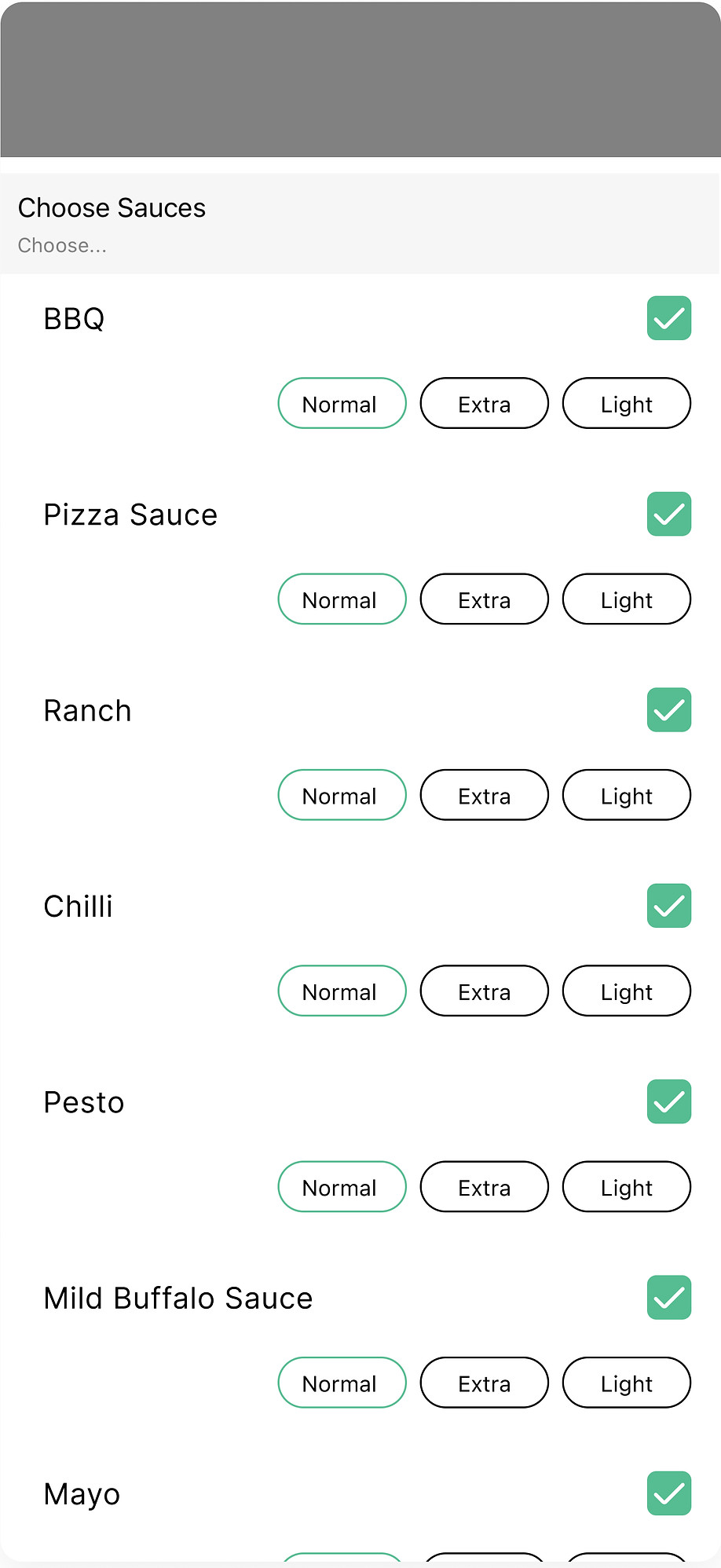
Option sets and modifier quantities wireframes
Exploration of modifier quantity controls and clearer option grouping patterns


Half-Half configuration wireframes
Half-half component and full screen layout


Building on the simplified architecture, I explored layout and interaction patterns that reduced cognitive load without compromising Jet’s brand identity.
While the structure became more progressive and modular, visual styling remained aligned with Jet’s brand guidelines - bold headers, high-contrast CTAs, and clear product imagery - ensuring the redesign felt like an evolution rather than a platform override.
Scroll to see visual concepts
Design & Visual Exploration


Final Concept
The final design balanced usability with operational complexity, resulting in a scalable ordering experience ready for national rollout. Deployed in phases from September 2024 to March 2026, the platform successfully transitioned all the Jet's franchise locations across the United States onto the new system.


Impact & Outcomes
"October 2025 was officially the biggest digital sales month in Jet's Pizza history.
Jet's Pizza Head Office - Detroit, Michigan
Business Outcomes
99.9%
Order accuracy across POS integrations
1000+
Live transactions validation pre-launch
12%
Increase in add-on selections per order
9%
Increase in completed orders
6x
Digital sales vs 2019 baseline
22.5%
Year on year digital growth
$40M+
Historic digital sales month
475
U.S. locations
deployed
Designing for 475 locations changed the stakes. Every interaction had to work reliably within real operational constraints, not just look polished on a screen.
This project reinforced the importance of simplifying complex systems without breaking business logic. Balancing nested configuration rules, legacy POS integrations, and brand expectations required careful structure and iteration.
Throughout the process, I incorporated AI-assisted LLM tools such as ChatGPT and UXPilot to accelerate flow mapping, explore edge cases, and prototype interaction patterns,using them to support decision-making rather than replace it.
Validating the experience through real-store testing before national rollout ensured the final solution worked not just in theory, but in practice.
Key Takeaways
© 2026 by Ariana Yeung